


Downing strengthens Energy & Infrastructure team with senior appointments
Learn moreInstitutional Investments


Why now is the time for the LGPS to invest in renewables
4/2/26
15 min
Renewable energy
Insight

A turning point for the UK's energy future
The UK is entering one of the most important phases of the energy transition. Over the coming years, the scale and urgency of required investment will reshape the country’s power system, industrial landscape and long‑term economic resilience. For the Local Government Pension Scheme (LGPS), this moment offers a rare combination of long‑term financial opportunity and national strategic importance. Renewable energy is no longer just a compelling asset class for diversification; it has become central to the UK’s ambition to build a stable, reliable and secure future. Recent geopolitical events have underscored how energy security is indivisible from national security.
A new global reality: why domestic renewables matter more than ever
What makes this transition different from previous energy milestones is the global context. The past three years of energy volatility have laid bare the risks inherent in relying on international fossil‑fuel markets or indeed, even traditional allies. Geopolitical conflict, supply interruptions and price instability have demonstrated that imported energy, particularly gas, can no longer form the backbone of a secure UK system.
Renewable energy fundamentally changes that exposure. By generating power within your own borders, using resources that are abundant, scalable and cost‑efficient, the UK can reduce its vulnerability to global disruptions and geopolitics.1 Domestic renewables lower reliance on unstable markets and restore control over the security and affordability of supply. For an economy that has been historically shaped by imported fuels, this shift represents a structural strengthening of national resilience.
This strategic value extends far beyond decarbonisation. Renewables sit at the intersection of energy independence, digital growth, and industrial competitiveness. The rise of artificial intelligence, cloud services and data centre infrastructure is dramatically increasing electricity demand. Forecasts suggest UK data centre power consumption could rise four-fold by 2030.2 Without significant renewable expansion, the cost and availability of electricity could become limiting factors for digital growth. As such, renewable investment now underpins not only the UK’s energy pathway, but also its technological and economic trajectory.
The investment case: long‑term, reliable and secure
After decades of underinvestment and poor planning, the government has turned over a new leaf. Market reform, grid reform and the introduction of a holistic plan for the evolution of our energy system has resulted in a tumultuous 18 months, but the fruits of clear and consistent policy are now beginning to show.
Combined with the ambition of the Clean Power 2030 and Net Zero 2050 targets (irrespective of whether they are actually achieved, as getting close to them would be a seminal achievement) you have what all investors want from government; clarity, ambition and consistency. With these three essentials, the UK renewable energy sector is once again presenting a compelling investment case.
Market Opportunity
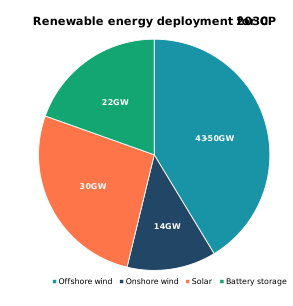
Assets are being created at unprecedented scale and the capital required is enormous. Electricity demand is forecast to more than double compared with 2020 levels as electrification accelerates across transport, heating, industry and digital infrastructure.3 To meet that demand, the National Energy System Operator (NESO) CP2030 Implementation Plan sees more than £200 billion4 deployed into between 43 and 50 GW of offshore wind, 14 GW of onshore wind, over 30 GW of solar, and up to 22 GW of battery storage, alongside extensive upgrades to the national grid, all by 2030.5
The Contract-for-Difference regime (CfD) is the main delivery mechanism for renewable energy generation assets. Annual auctions are run for 15-20 year fixed-price, inflation-linked power purchase contracts for 100% of the power produced. Once secured, these are extremely attractive, long-dated revenue streams that are attracting domestic and international investor interest.
The UK mid‑market presents especially attractive opportunities with less global competition and often offer superior return potential. Whilst there are many operational projects in the market, there are huge opportunities to acquire and build projects. A wave of ready‑to‑build assets is expected to enter the market as grid‑connection timelines accelerate through 2026 and beyond. This creates a favourable environment for investors able to deploy capital into both operating and near‑term construction opportunities.
Disciplined fund managers can unlock additional value through capex optimisation, portfolio‑wide operational strategies and active revenue management. With high‑quality exit markets and sustained demand from global strategics, infrastructure funds and pension schemes, liquidity remains strong and valuations remain well supported.
A strategic moment for the LGPS
.JPG)
Renewables sit at the heart of what the UK now needs most: long‑term stability, dependable supply and domestic security. In a world where old energy alliances can no longer be relied upon, creating a homegrown renewable system is no longer a choice - it is a necessity.
LGPS investors are uniquely positioned to play a defining role in this transition. Their long‑term capital horizon, appetite for stable yields and commitment to supporting local communities place them at the centre of the UK’s renewable build‑out.
Investing in renewables today is not simply about climate leadership or responsible investment - though it delivers both. It is about strengthening the UK’s future resilience, ensuring economic stability, and securing affordable, reliable energy for generations. In doing so, LGPS funds can deliver strong, steady returns while contributing meaningfully to a more secure and prosperous national future.
If you’d like to explore how renewables can support your long-term objectives, click here.
This was first published on LAPF Investments.
-
Share



Contents
See full contents

Building a resilient, homegrown energy system is now both a financial opportunity and a national necessity and renewables are critical to delivering it.
A turning point for the UK's energy future
The UK is entering one of the most important phases of the energy transition. Over the coming years, the scale and urgency of required investment will reshape the country’s power system, industrial landscape and long‑term economic resilience. For the Local Government Pension Scheme (LGPS), this moment offers a rare combination of long‑term financial opportunity and national strategic importance. Renewable energy is no longer just a compelling asset class for diversification; it has become central to the UK’s ambition to build a stable, reliable and secure future. Recent geopolitical events have underscored how energy security is indivisible from national security.
A new global reality: why domestic renewables matter more than ever
What makes this transition different from previous energy milestones is the global context. The past three years of energy volatility have laid bare the risks inherent in relying on international fossil‑fuel markets or indeed, even traditional allies. Geopolitical conflict, supply interruptions and price instability have demonstrated that imported energy, particularly gas, can no longer form the backbone of a secure UK system.
Renewable energy fundamentally changes that exposure. By generating power within your own borders, using resources that are abundant, scalable and cost‑efficient, the UK can reduce its vulnerability to global disruptions and geopolitics.1 Domestic renewables lower reliance on unstable markets and restore control over the security and affordability of supply. For an economy that has been historically shaped by imported fuels, this shift represents a structural strengthening of national resilience.
This strategic value extends far beyond decarbonisation. Renewables sit at the intersection of energy independence, digital growth, and industrial competitiveness. The rise of artificial intelligence, cloud services and data centre infrastructure is dramatically increasing electricity demand. Forecasts suggest UK data centre power consumption could rise four-fold by 2030.2 Without significant renewable expansion, the cost and availability of electricity could become limiting factors for digital growth. As such, renewable investment now underpins not only the UK’s energy pathway, but also its technological and economic trajectory.
The investment case: long‑term, reliable and secure
After decades of underinvestment and poor planning, the government has turned over a new leaf. Market reform, grid reform and the introduction of a holistic plan for the evolution of our energy system has resulted in a tumultuous 18 months, but the fruits of clear and consistent policy are now beginning to show.
Combined with the ambition of the Clean Power 2030 and Net Zero 2050 targets (irrespective of whether they are actually achieved, as getting close to them would be a seminal achievement) you have what all investors want from government; clarity, ambition and consistency. With these three essentials, the UK renewable energy sector is once again presenting a compelling investment case.
Market Opportunity
Assets are being created at unprecedented scale and the capital required is enormous. Electricity demand is forecast to more than double compared with 2020 levels as electrification accelerates across transport, heating, industry and digital infrastructure.3 To meet that demand, the National Energy System Operator (NESO) CP2030 Implementation Plan sees more than £200 billion4 deployed into between 43 and 50 GW of offshore wind, 14 GW of onshore wind, over 30 GW of solar, and up to 22 GW of battery storage, alongside extensive upgrades to the national grid, all by 2030.5
The Contract-for-Difference regime (CfD) is the main delivery mechanism for renewable energy generation assets. Annual auctions are run for 15-20 year fixed-price, inflation-linked power purchase contracts for 100% of the power produced. Once secured, these are extremely attractive, long-dated revenue streams that are attracting domestic and international investor interest.
The UK mid‑market presents especially attractive opportunities with less global competition and often offer superior return potential. Whilst there are many operational projects in the market, there are huge opportunities to acquire and build projects. A wave of ready‑to‑build assets is expected to enter the market as grid‑connection timelines accelerate through 2026 and beyond. This creates a favourable environment for investors able to deploy capital into both operating and near‑term construction opportunities.
Disciplined fund managers can unlock additional value through capex optimisation, portfolio‑wide operational strategies and active revenue management. With high‑quality exit markets and sustained demand from global strategics, infrastructure funds and pension schemes, liquidity remains strong and valuations remain well supported.
A strategic moment for the LGPS
Renewables sit at the heart of what the UK now needs most: long‑term stability, dependable supply and domestic security. In a world where old energy alliances can no longer be relied upon, creating a homegrown renewable system is no longer a choice - it is a necessity.
LGPS investors are uniquely positioned to play a defining role in this transition. Their long‑term capital horizon, appetite for stable yields and commitment to supporting local communities place them at the centre of the UK’s renewable build‑out.
Investing in renewables today is not simply about climate leadership or responsible investment - though it delivers both. It is about strengthening the UK’s future resilience, ensuring economic stability, and securing affordable, reliable energy for generations. In doing so, LGPS funds can deliver strong, steady returns while contributing meaningfully to a more secure and prosperous national future.
If you’d like to explore how renewables can support your long-term objectives, click here.
This was first published on LAPF Investments.
-
Share
Building a resilient, homegrown energy system is now both a financial opportunity and a national necessity and renewables are critical to delivering it.
A turning point for the UK's energy future
The UK is entering one of the most important phases of the energy transition. Over the coming years, the scale and urgency of required investment will reshape the country’s power system, industrial landscape and long‑term economic resilience. For the Local Government Pension Scheme (LGPS), this moment offers a rare combination of long‑term financial opportunity and national strategic importance. Renewable energy is no longer just a compelling asset class for diversification; it has become central to the UK’s ambition to build a stable, reliable and secure future. Recent geopolitical events have underscored how energy security is indivisible from national security.
A new global reality: why domestic renewables matter more than ever
What makes this transition different from previous energy milestones is the global context. The past three years of energy volatility have laid bare the risks inherent in relying on international fossil‑fuel markets or indeed, even traditional allies. Geopolitical conflict, supply interruptions and price instability have demonstrated that imported energy, particularly gas, can no longer form the backbone of a secure UK system.
Renewable energy fundamentally changes that exposure. By generating power within your own borders, using resources that are abundant, scalable and cost‑efficient, the UK can reduce its vulnerability to global disruptions and geopolitics.1 Domestic renewables lower reliance on unstable markets and restore control over the security and affordability of supply. For an economy that has been historically shaped by imported fuels, this shift represents a structural strengthening of national resilience.
This strategic value extends far beyond decarbonisation. Renewables sit at the intersection of energy independence, digital growth, and industrial competitiveness. The rise of artificial intelligence, cloud services and data centre infrastructure is dramatically increasing electricity demand. Forecasts suggest UK data centre power consumption could rise four-fold by 2030.2 Without significant renewable expansion, the cost and availability of electricity could become limiting factors for digital growth. As such, renewable investment now underpins not only the UK’s energy pathway, but also its technological and economic trajectory.
The investment case: long‑term, reliable and secure
After decades of underinvestment and poor planning, the government has turned over a new leaf. Market reform, grid reform and the introduction of a holistic plan for the evolution of our energy system has resulted in a tumultuous 18 months, but the fruits of clear and consistent policy are now beginning to show.
Combined with the ambition of the Clean Power 2030 and Net Zero 2050 targets (irrespective of whether they are actually achieved, as getting close to them would be a seminal achievement) you have what all investors want from government; clarity, ambition and consistency. With these three essentials, the UK renewable energy sector is once again presenting a compelling investment case.
Market Opportunity
Assets are being created at unprecedented scale and the capital required is enormous. Electricity demand is forecast to more than double compared with 2020 levels as electrification accelerates across transport, heating, industry and digital infrastructure.3 To meet that demand, the National Energy System Operator (NESO) CP2030 Implementation Plan sees more than £200 billion4 deployed into between 43 and 50 GW of offshore wind, 14 GW of onshore wind, over 30 GW of solar, and up to 22 GW of battery storage, alongside extensive upgrades to the national grid, all by 2030.5
The Contract-for-Difference regime (CfD) is the main delivery mechanism for renewable energy generation assets. Annual auctions are run for 15-20 year fixed-price, inflation-linked power purchase contracts for 100% of the power produced. Once secured, these are extremely attractive, long-dated revenue streams that are attracting domestic and international investor interest.
The UK mid‑market presents especially attractive opportunities with less global competition and often offer superior return potential. Whilst there are many operational projects in the market, there are huge opportunities to acquire and build projects. A wave of ready‑to‑build assets is expected to enter the market as grid‑connection timelines accelerate through 2026 and beyond. This creates a favourable environment for investors able to deploy capital into both operating and near‑term construction opportunities.
Disciplined fund managers can unlock additional value through capex optimisation, portfolio‑wide operational strategies and active revenue management. With high‑quality exit markets and sustained demand from global strategics, infrastructure funds and pension schemes, liquidity remains strong and valuations remain well supported.
A strategic moment for the LGPS
Renewables sit at the heart of what the UK now needs most: long‑term stability, dependable supply and domestic security. In a world where old energy alliances can no longer be relied upon, creating a homegrown renewable system is no longer a choice - it is a necessity.
LGPS investors are uniquely positioned to play a defining role in this transition. Their long‑term capital horizon, appetite for stable yields and commitment to supporting local communities place them at the centre of the UK’s renewable build‑out.
Investing in renewables today is not simply about climate leadership or responsible investment - though it delivers both. It is about strengthening the UK’s future resilience, ensuring economic stability, and securing affordable, reliable energy for generations. In doing so, LGPS funds can deliver strong, steady returns while contributing meaningfully to a more secure and prosperous national future.
If you’d like to explore how renewables can support your long-term objectives, click here.
This was first published on LAPF Investments.
-
Share
A turning point for the UK's energy future
The UK is entering one of the most important phases of the energy transition. Over the coming years, the scale and urgency of required investment will reshape the country’s power system, industrial landscape and long‑term economic resilience. For the Local Government Pension Scheme (LGPS), this moment offers a rare combination of long‑term financial opportunity and national strategic importance. Renewable energy is no longer just a compelling asset class for diversification; it has become central to the UK’s ambition to build a stable, reliable and secure future. Recent geopolitical events have underscored how energy security is indivisible from national security.
A new global reality: why domestic renewables matter more than ever
What makes this transition different from previous energy milestones is the global context. The past three years of energy volatility have laid bare the risks inherent in relying on international fossil‑fuel markets or indeed, even traditional allies. Geopolitical conflict, supply interruptions and price instability have demonstrated that imported energy, particularly gas, can no longer form the backbone of a secure UK system.
Renewable energy fundamentally changes that exposure. By generating power within your own borders, using resources that are abundant, scalable and cost‑efficient, the UK can reduce its vulnerability to global disruptions and geopolitics.1 Domestic renewables lower reliance on unstable markets and restore control over the security and affordability of supply. For an economy that has been historically shaped by imported fuels, this shift represents a structural strengthening of national resilience.
This strategic value extends far beyond decarbonisation. Renewables sit at the intersection of energy independence, digital growth, and industrial competitiveness. The rise of artificial intelligence, cloud services and data centre infrastructure is dramatically increasing electricity demand. Forecasts suggest UK data centre power consumption could rise four-fold by 2030.2 Without significant renewable expansion, the cost and availability of electricity could become limiting factors for digital growth. As such, renewable investment now underpins not only the UK’s energy pathway, but also its technological and economic trajectory.
The investment case: long‑term, reliable and secure
After decades of underinvestment and poor planning, the government has turned over a new leaf. Market reform, grid reform and the introduction of a holistic plan for the evolution of our energy system has resulted in a tumultuous 18 months, but the fruits of clear and consistent policy are now beginning to show.
Combined with the ambition of the Clean Power 2030 and Net Zero 2050 targets (irrespective of whether they are actually achieved, as getting close to them would be a seminal achievement) you have what all investors want from government; clarity, ambition and consistency. With these three essentials, the UK renewable energy sector is once again presenting a compelling investment case.
Market Opportunity
Assets are being created at unprecedented scale and the capital required is enormous. Electricity demand is forecast to more than double compared with 2020 levels as electrification accelerates across transport, heating, industry and digital infrastructure.3 To meet that demand, the National Energy System Operator (NESO) CP2030 Implementation Plan sees more than £200 billion4 deployed into between 43 and 50 GW of offshore wind, 14 GW of onshore wind, over 30 GW of solar, and up to 22 GW of battery storage, alongside extensive upgrades to the national grid, all by 2030.5
The Contract-for-Difference regime (CfD) is the main delivery mechanism for renewable energy generation assets. Annual auctions are run for 15-20 year fixed-price, inflation-linked power purchase contracts for 100% of the power produced. Once secured, these are extremely attractive, long-dated revenue streams that are attracting domestic and international investor interest.
The UK mid‑market presents especially attractive opportunities with less global competition and often offer superior return potential. Whilst there are many operational projects in the market, there are huge opportunities to acquire and build projects. A wave of ready‑to‑build assets is expected to enter the market as grid‑connection timelines accelerate through 2026 and beyond. This creates a favourable environment for investors able to deploy capital into both operating and near‑term construction opportunities.
Disciplined fund managers can unlock additional value through capex optimisation, portfolio‑wide operational strategies and active revenue management. With high‑quality exit markets and sustained demand from global strategics, infrastructure funds and pension schemes, liquidity remains strong and valuations remain well supported.
A strategic moment for the LGPS
Renewables sit at the heart of what the UK now needs most: long‑term stability, dependable supply and domestic security. In a world where old energy alliances can no longer be relied upon, creating a homegrown renewable system is no longer a choice - it is a necessity.
LGPS investors are uniquely positioned to play a defining role in this transition. Their long‑term capital horizon, appetite for stable yields and commitment to supporting local communities place them at the centre of the UK’s renewable build‑out.
Investing in renewables today is not simply about climate leadership or responsible investment - though it delivers both. It is about strengthening the UK’s future resilience, ensuring economic stability, and securing affordable, reliable energy for generations. In doing so, LGPS funds can deliver strong, steady returns while contributing meaningfully to a more secure and prosperous national future.
If you’d like to explore how renewables can support your long-term objectives, click here.
This was first published on LAPF Investments.
-

Please fill out the form to download the full report
Share
Sign up to stay up to date with the latest insights and investment opportunities
Learn more






Downing LLP does not provide advice or make personal recommendations and investors are strongly urged to seek independent advice before investing. Investments offered on this website carry a higher risk than many other types of investment and prospective investors should be aware that capital is at risk and the value of their investment may go down as well as up. Any investment should only be made on the basis of the relevant product literature and your attention is drawn to the risk, fees and taxation factors contained therein. Tax treatment depends on individual circumstances of each investor and may be subject to change in the future. Past performance is not a reliable indicator of future performance. Downing LLP is authorised and regulated by the Financial Conduct Authority (Firm Reference Number 545025). Registered in England No. OC341575. Registered Office: Downing, 10 Lower Thames Street, London, EC3R 6AF.
VAT Number: 112 940 149